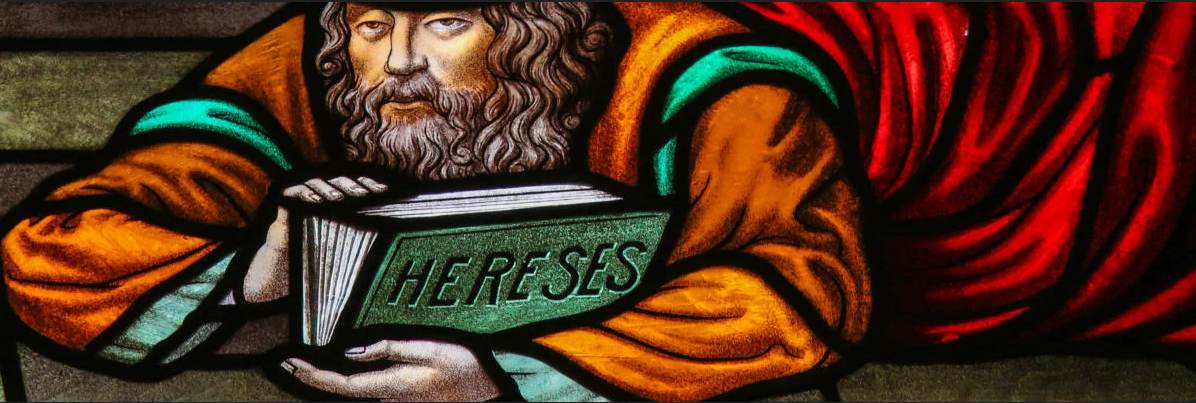
If the passing of the last of the first apostles brought about a crisis, we have no clear record of this. These same apostles presented all that God had provided in Christ, also preparing us for their departure. We would continue in the presence of Christ alongside their spirit. Neither was there question of survival; even as the Master had spoken of His ekklesia, "the gates of Hades shall not overpower." God in Christ both building and sustaining.
[Matthew 16:18]
"Self-policing"? "Massive problem"? "...desperate to weed out the fakes"? This is the language of fear; even alarmism. Such is not the example set nor the teaching of the first century saints. Men had indeed been put out for destructive behavior lacking repentance, though none recorded as sent out to discipline for what be a weakness of doctrine. Neither is disagreement described as contextual of "mutiny". Different understandings would arise, and as Paul would answer potential contention with, "we have no other practice." No viable test of wills, as we are not our own where the death-to-life and authority of Christ prevails.
Clement of Rome writes to Corinth of those who in arrogance and unruliness have set themselves up as leaders in abominable jealousy. And also, For Christ is with them that are lowly of mind, not with them that exalt themselves over the flock. And also, It is shameful, dearly beloved, yes, utterly shameful and unworthy of your conduct in Christ, that it should be reported that the very steadfast and ancient Church of the Corinthians, for the sake of one or two persons, makes sedition against its presbyters. And further, let us entreat that we may obtain forgiveness. Yes and they also, who set themselves up as leaders of faction and division, ought to look to the common ground of hope.
Apostolic succession? Clement of Rome doesn't present it. Christ being reliable and able to bring the "final word" from above. We need not prepare to elect another. For if or where we lack consensus in the Spirit, even there we have His upon which to wait.
Ignatius of Antioch
To consider the letters of Ignatius, we need acknowledge tradition regarding the life & writings ascribed to him. He suddenly appears from history without former confession or testimony. The anxious pen of "Ignatius" bleeding instructions for a hierarchical system previously unknown to the flock; an order such as contrary to the teachings of Christ among His disciples. Are we to assume that the saints in Ephesus, Smyrna, Magnesia, Philadelphia, Tralles, Rome, and the man named Polycarp, conformed to the appeals of Ignatius, thereby without help importing a structure previously determined to be alien to the saints while so much like that of the Roman world surrounding them? Yet history tells of a more gradual development toward the saving heirarchy today favored from Rome.
Is (or was) Docetism a serious threat to faith? Hardly. Those alive today who are in Christ, also are acknowledged to be His body. By this, the proposed 'Jesus without flesh' is maimed as an assertion inconsequential; developed beneath an immaturity or infirmity of faith. The essential presence of spurious ideas does not turnabout the unity of faith. Rather, shortfalls or the counterfeit behind us help to confirm Christ's abiding prayer of unity for us. John has written, They went out from us, but they were not really of us; for if they had been of us, they would have remained with us; but they went out, in order that it might be shown that they all are not of us.[I John 2:19]
The faithful "logic" simpler still: There is one body and one Spirit, just as also you were called in one hope of your calling; one Lord, one faith, one baptism, one God and Father of all who is over all and through all and in [you/us] all. [Ephesians 4:4-6] Being found in Christ is not an identity crisis. What matters we do agree about cannot serve to define our True identity, as Christ is our [new] identity. If you want to know who He is and what He teaches, you go to Him, finding the Father in and thru Him. Christ is the Source; the Head. [Ephesians 4:15] In Christ, where can be space for some other to lead the people of God?
They Built For Fear of Men
Nothing truly of God is built upon the fear of men or message. Various sects, ancient or modern, continue to press forward and may multiply. Yet, what Christ has long been building was never truly in danger of being lost. Neither does His Bride nor His assembly have need of lofty efforts; anxious or frightened men, for Her to become much more than a survivor. [I Corinthians 1:11-13; 2:2, 5]
How may we lay claim to be universal or in accord with the whole? There is but One Bridegroom; and One Bride to be.
The Authority of Christ
Two Expression of Divine Authority
Being with Jesus for 15 minutes did not in itself perfect the authority of Christ in Paul.
the Apostles were in practice to have "appointed" more than one, knowing that some would die under persecution; some also may be carried away.
God has not ceased from sending us out within His authority in Christ
What Scrolling Cannot Replace
Scripture is quoted by someone, where nothing follows by the Spirit of God. The authority of Christ does not abide in the text itself. The authority of Christ may not be abiding...
Where the Adversary "quotes Scripture", this does not bring the same in authority as where Christ or the saints are moved to quote it.
In Word And Power
[Paul's refs]
The Roman Excuse: 'We Didn't Do This To Add Power, We Did This So That The Church Would Survive."
(human reasoning: having much the opposite in effect)
The move to exercise authoirty was not itself undertaken within the authority of Christ; instead, trying to 'save the Church' via human authority structures served to establish a religious order which did in time, turn about to chase and attack saints of the Kingdom of God.